
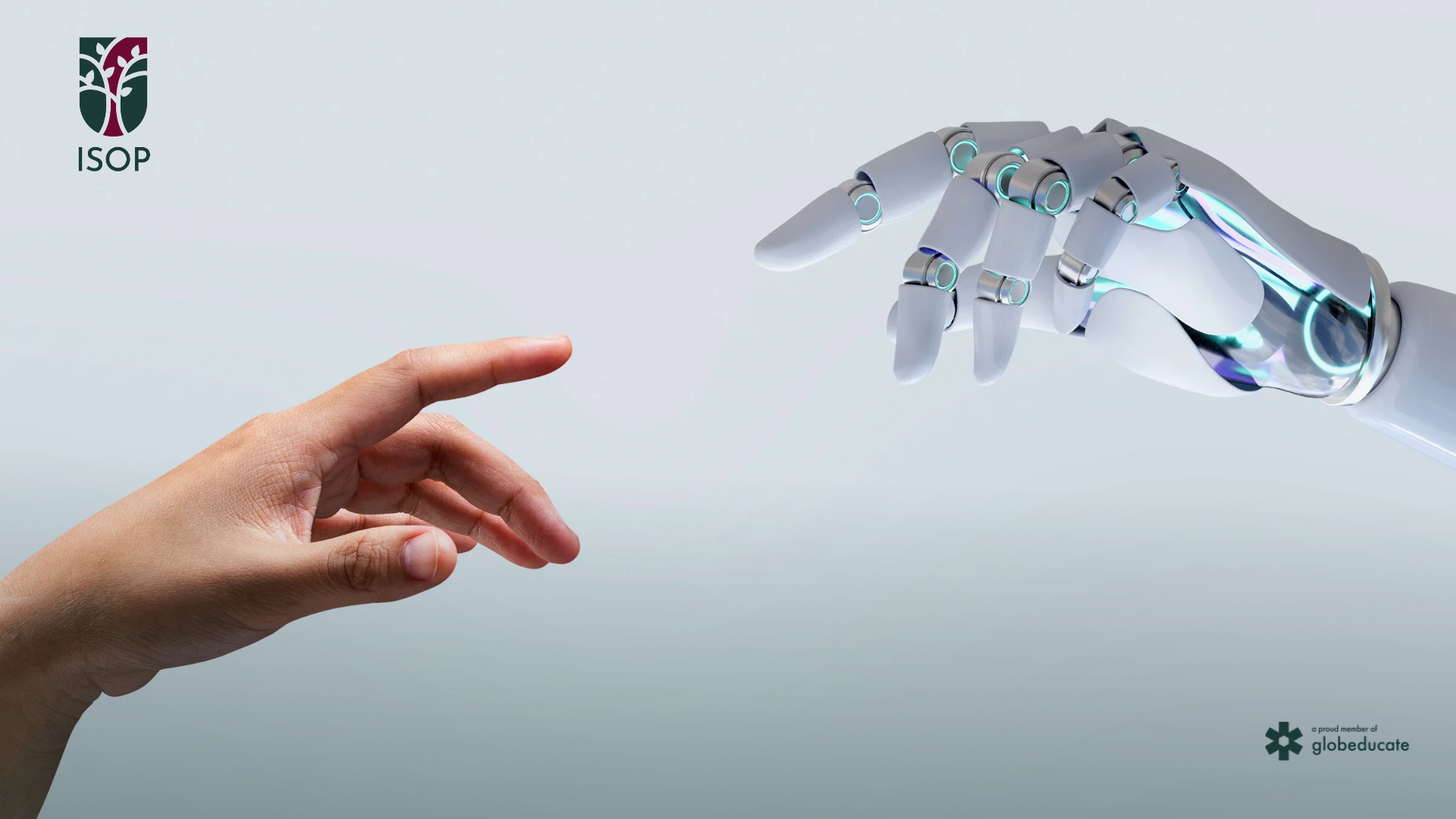
Having recently read Ethan Mollick’s book CO-INTELLIGENCE, it made me realise how, as educators and parents, we have an obligation to the next generation – to ensure they do not lose the basic skills in education that they will need to thrive in the new world we are creating with Artificial Intelligence, AI.
As was referenced in the book, currently we work as Cyborgs – the electronics being an integral part of our daily lives. They may not be implanted, but they are certainly part of us. How many days, or even hours could you manage without your mobile devices, TVs, washing machines, dishwashers, robotic vacuum? Electronics have crept into our daily lives, more and more. AI is a way of using these electronics and it should be trained in such a way to make our lives easier and tasks quicker. Therefore, we should not be under the misunderstanding that we do not need knowledge.
AI is currently trained on the knowledge that we have, the knowledge that we give it. It looks for patterns and predictions, and so its output always needs to be reviewed. If we do not have the knowledge, we cannot move forward in our thinking or train AI to be better, as we would not know how to. So purely from a progression point of view, it is clear that we still need knowledge, and the ability to critically think and progress with our ideas.
In school, students could use AI for generating answers and completing assignments, but they still have to check the facts, the writing, the output. Yes, we should be teaching knowledge but also skills. The skills to research, to provide a good prompt for AI to give the information in a way that it is best presented. But without the knowledge of language and how best to present the information, or if indeed that information is correct, then we are failing the next generation. Research means checking your information; is it reliable, is it from a source that you trust? Can you see if it comes from a study, or is it someone’s opinion? Where did AI takes its information from? Did you give it a good enough prompt for it to do its job correctly? If you give a good prompt, telling it what you want, perhaps the source from where you want the information, what you would like the information to tell you? And importantly, are there any biases in the information? Over the last decade, we have become more aware of bias in education, and within our textbooks. Science books, for example, used to talk about the changes in European Science, ignoring the rest of the world. Being aware of bias is good, in the same way as being aware of the reliability of your information.
AI can be used, should be used. I am from a generation that lived before Google. In a time when Google became widespread, we had to adapt to how it would impact our lives and how easy finding information would be, and the speed at which it was possible. This was improved with the introduction of WiFi and Smartphones where the information became instantly available. AI takes that a step further that you no longer have to scroll to find the information but it will do this for you. BUT you still have to evaluate it and this is the skill we developed with the internet and search engines – now it needs refining to adapt to AI. During this period, we have had to battle the dilemma of cost. Who is providing this, who is paying for it? This led to the rise of selling data – something that we need to be very aware of and teach our young people to keep themselves safe.
But what about after school? AI is not destroying how we work but undermining the hidden system of apprenticeship that comes after formal education. It reduces the need for low-paid assistants who used to find the information, write the reports, and in doing so were learning the job. Now it will be harder for our young people to find a way into the work place, but if they use AI effectively they will be able to take that leap into this and so – are we teaching our young people how to work effectively with AI? If we are not, then we are failing their future employability.
Claire Polycarpou
Headteacher of Secondary School